
Boston College. Board of Trustees
Dates
- Existence: 1863-present
Biography
Boston College has been governed at various points in its history by three distinct bodies: the Board of Trustees, the Board of Regents, and the Board of Directors. These entities were not parallel structures that coexisted indefinitely. Rather, they reflect successive and sometimes overlapping phases of a governance evolution that unfolded across roughly a century and a half.
Boston College was incorporated under Massachusetts law on April 1, 1863, by an act of the General Court of the Commonwealth entitled "An Act to Incorporate the Trustees of Boston College." The five persons named in the act - John McElroy, SJ; Edward H. Welch, SJ; John Bapst, SJ; James Clark, SJ; and Charles H. Stonestreet, SJ - constituted the first Board of Trustees, which met on July 6, 1863, to accept the act of incorporation, and again on July 10 to adopt bylaws and elect officers.
Consistent with Jesuit educational practice in the United States, the original Board of Trustees was composed entirely of Jesuits and limited by the Massachusetts charter to ten members. Under this model, the offices of university president and Jesuit rector were held by the same individual, appointed by the Father General of the Society of Jesus in Rome and then formally elected by the trustees. Ultimate institutional authority rested with the Jesuit hierarchy, flowing from Rome through the provincial superior to the local community. The ten Jesuit trustees held paramount legal authority under the corporate charter and reserved to themselves the critical prerogatives of amending the University's statutes and electing the president.
The Board of Regents was established in 1959 during the administration of President Michael P. Walsh, SJ, as an advisory body to supplement the work of the all-Jesuit Board of Trustees. Its first meeting was held on September 27, 1960. The board drew on models at other Jesuit universities and was organized in collaboration with Thomas J. Cudmore, director of the Office of Development, who assisted in identifying candidates from among prominent alumni, civic leaders, and business figures in the Greater Boston area. Henry M. Leen served as the first chairman; Christopher Duncan, who had led the Centennial Development Program, was also among the early members.
The Board of Regents held no formal governance authority and was not a corporate body. Its function was to advise the president on matters of capital development and deficit financing, assist with long-range planning, and promote public understanding of the University. The board was abolished in 1968, when its members were invited to join the newly constituted Board of Directors.
By the mid-1960s, a movement within Jesuit higher education toward lay participation in university governance had gained momentum, led in part by Paul C. Reinert, SJ, president of St. Louis University and of the Jesuit Educational Association. At Boston College, the initiative took shape during the administration of Michael P. Walsh, SJ, and was carried forward by his successor, W. Seavey Joyce, SJ. In 1967, the Board of Trustees voted unanimously to amend the bylaws and establish a two-board structure. The existing Board of Trustees, composed entirely of Jesuits, would retain paramount legal authority. A new body, the Board of Directors, would include Jesuits, laymen, and women, not more than twenty-five members, and would hold operational authority over the University's affairs.
The 1967 bylaws revision delegated to the Board of Directors authority over educational policy, the granting of degrees, university statutes, tenure and promotion, the establishment of new schools or institutes, the budget, and the sale or purchase of property. The Jesuit trustees retained the authority to amend the charter and to elect the president. The bylaws also removed the president of Boston College from the chairmanship of the Board of Trustees; Joseph L. Shea, SJ, then rector of Cheverus High School in Portland, Maine, was elected the first non-presidential chairman.
The Board of Directors met for the first time on October 8, 1968, with Henry Leen - formerly chairman of the Board of Regents - elected as its chairman. Its membership drew on former Regents, Jesuit members of the old Board of Trustees, and newly appointed lay members including Robert F. Byrnes and Joseph G. Brennan.
The dual-board structure proved difficult to sustain in practice, generating duplication and ambiguity over which body held proper authority for particular decisions. On November 19, 1972, the trustees voted unanimously to merge both boards into a single Board of Trustees with an initial membership of thirty-five. The reconstituted board met for the first time on December 8, 1972, with Joseph L. Shea, SJ, presiding as chairman and J. Donald Monan, SJ, introducing the new members. New bylaws were adopted by resolution on December 7, 1972.
The composition of the new board - thirty-three men and two women, twenty-two laypeople and thirteen Jesuits, thirty-three white members and two Black members - represented a substantial departure from the ten-member all-Jesuit body that had governed the institution since 1863. Cornelius W. Owens was elected the first chairman of the expanded board.The consolidation at Boston College reflected a broader transformation underway across Jesuit higher education, in which lay participation in university governance had become the prevailing model.
The current bylaws, adopted December 7, 1972, and amended periodically since, establish the Board of Trustees as the paramount legal authority of the corporation. The Board must consist of twenty-one or more members, with the exact number determined by majority vote of the full Board. Among the Board's most consequential powers is the election of the president of Boston College. The president of Boston College serves as an ex officio member.
Trustees are elected by majority vote of the full Board for terms of one, two, three, or four years, with terms staggered so that at least one-fifth of trustees are elected or reelected each year. No trustee who has served eight consecutive years may be reelected until a full year has elapsed; no trustee may remain on the Board past the fiscal year in which they turn seventy-five. Both limits may be waived by a two-thirds vote of the full Board.
The bylaws enumerate seventeen powers reserved to the full Board, including electing the president, amending the charter, approving educational policy and new degree programs, acting on the granting of honorary degrees, authorizing tuition changes, approving construction and major renovation, authorizing the purchase and sale of land, approving major fund-raising activities, and accepting restricted gifts involving major obligations. Between board meetings, an Executive Committee - consisting of the Chairman and the president of Boston College (both ex officio) and five or more elected trustees - manages ordinary University business. The Board officers are a Chairman, Vice Chairman, and Secretary, elected annually; the president of Boston College is not an officer of the Board
Found in 3 Collections and/or Records:
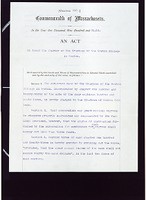
Charter of Boston College and amendments
Consists of the original and certified copies of the charter of incorporation for Boston College (1863), as well as amendments (1908 and 1959).
Collection is open for research; access restricted to the digital version.
W. Seavey Joyce, SJ, President’s Office records
Collection is closed. Access with permission of office. Departmental records and faculty files containing student records, faculty tenure and promotion files, and other records containing personally identifiable information are closed due to privacy restrictions.
Michael P. Walsh, SJ, President's Office records
Collection is open for research. Series I. Admissions is closed in its entirety due to privacy restrictions, and is stored off-site. A small amount of material in other series is also closed due to privacy restrictions.